
August 21, 2026, 1:42 pm
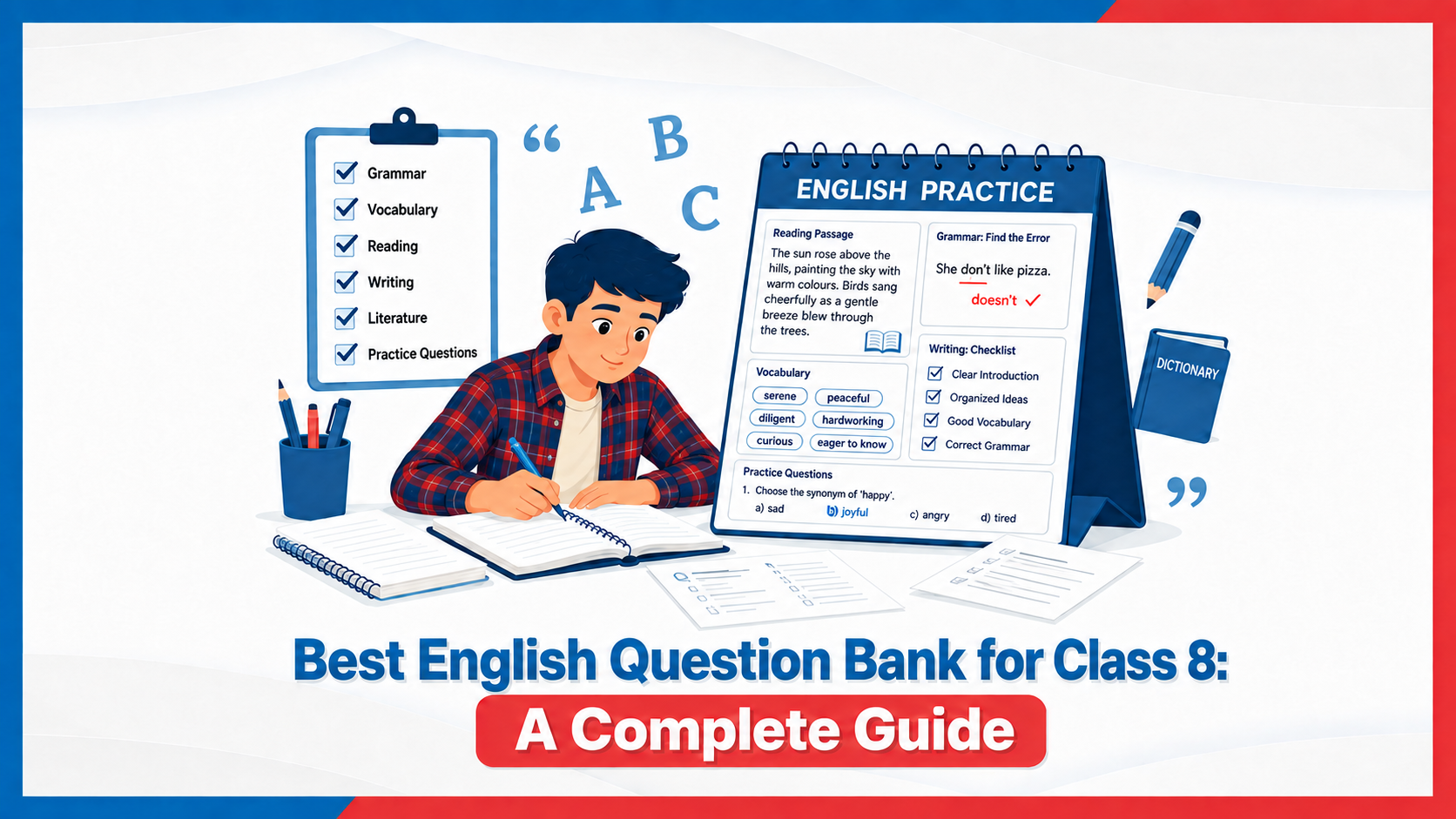
Reading the textbook helps Class 8 students cover the syllabus only. It does not prepare them for the various questioning styles within the same chapter. That’s where a good English question bank comes in; it gives students practice on question formats they’ll actually face in exams, not just a summary of what they read.
Whether you’re a parent or student, this guide will help you through what to look for, what a question bank should cover, and how to use it so it actually improves scores instead of sitting on a shelf.
A question bank does more than add more questions to solve.
● It improves understanding chapter by chapter. Questions on a single chapter, worked through, can reveal gaps that a single reading will not.
● It gives practice beyond NCERT. The textbook explains the concepts, and the question bank tests them from different angles.
● It focuses on frequently asked topics. Across chapters, patterns emerge, and students begin to identify what examiners repeat.
● It enhances answer-writing skills. Knowing an answer is one skill, writing it well is another, and only practice builds the second.
● It boosts exam confidence. A student who has seen a question type 10 different ways walks into the exam with no surprises.
Not every question bank on the shelf justifies its price. Here’s the difference between a good one and a padded one.
Questions should be directly mapped to the prescribed syllabus covering prose, poetry and the supplementary reader without straying into topics beyond the curriculum.
Revision made easy with questions organised by chapter. A student studying for a test on one lesson shouldn't have to sort through a mixed set of practice questions to find the relevant ones.
A good question bank includes:
● MCQs
● Very short answer questions
● Short answer questions
● Long answer questions
● Application-based & case-based questions
Exams are no longer just about recall, nor should practice material be.
Step-by-step explanations show a student how to arrive at an answer, not just know the answer. When a student is still learning how to structure a response, the answer itself matters less than the process.
Boards have shifted from asking pure recall questions to asking application and inference questions. A question bank that does not recognise this change will leave students unprepared for the actual exam.
Students can practise solved exam-style papers under time constraints, allowing them to identify areas of weakness before the actual exam.
|
Area |
What Students Practise |
|
Prose |
Comprehension, character, theme, inference |
|
Poetry |
Meaning, poetic devices, interpretation |
|
Supplementary Reader |
Plot, characters, theme-based questions |
|
Grammar |
Rules and application |
|
Writing |
Letters, notices, essays, etc. |
|
Reading |
Unseen passages and comprehension |
Before you buy one, go through this checklist:
● Is this as per CBSE syllabus?
● Are all the chapters included, not just the popular ones?
● Is it a mix of question types, not mainly MCQs?
● Does it have competency based and inference questions?
● Do the answers explain and clarify? Or do they just list?
● Are there sample papers for timed practice?
● Are there any revision aids like summaries or quick-review sections?
A question bank that satisfies most of these criteria will last for the entire school year, not just the first month.
|
Feature |
Question Bank |
Practice Book |
|
Chapter-wise questions |
✓ |
✓ |
|
Exam-oriented questions |
✓ |
✓ |
|
Question variety |
High |
Moderate–High |
|
Revision |
✓ |
✓ |
|
Sample papers |
Often |
Sometimes |
|
Detailed explanations |
Usually |
Depends |
There is an overlap, but a Class 8 English practice book will tend to concentrate on repetition of one format, while a question bank will build range across formats and difficulty levels. Most students find both to be helpful, but if you have to choose one, the question bank covers more ground.
A question bank is most effective in three phases, not as a haphazard pile of questions to tackle the night before an exam.
Read the NCERT chapter first. Before you go to any questions on it, get to know the concepts and any new vocabulary.
Try the questions chapter wise. Attempt the competency based ones without skipping. Write the complete answer instead of thinking in your head.
Solve sample papers in time-bound conditions. Check the errors and determine the reason why they occurred. Revise chapter that keeps giving you the wrong answers.
● Memorising answers instead of understanding the concept.
● Skipping hard questions, rather than trying to solve.
● Only doing MCQs and not writing long answers.
● Ignoring grammar & writing section in favour of comprehension.
● Solving sample papers without analysing mistakes.
● Waiting for the last day to open the question bank.
All of these defeat the purpose of practice. A question bank English Class 8 is only useful if a student attempts every type of question, not just the easy ones.
There is no one right number, but here is a realistic range depending on where a student is:
● Beginner: 10-15 questions per day.
● Consistent practice: 15-25 questions per day.
● Before exam: 25-40 mixed questions per day.
Number is not important. Knowing the right answer is important. It's better to know ten questions well than answer forty without thinking.
A good question bank includes all the components mentioned above: syllabus alignment, chapter-wise organisation, variety of question formats, competency-based practice, clear explanations, revision support, and Class 8 English sample paper for exam-style practice.
Oswaal Class 8 English Question Bank follows the same structure, latest CBSE syllabus, chapter-wise coverage, and step-by-step detailed answers. Oswaal English book is the most practical choice if you are comparing what is available for 8th Class CBSE English book preparation.
Question bank is not a substitute for NCERT; it complements NCERT. Right question bank gives chapter-wise structured practice for Class 8 students in exam format. It also has explanations that really teach and not just answer keys to copy.
Before buying question bank for CBSE Class 8, look for syllabus alignment, variety of questions, and revision support, and then use it consistently throughout the year, rather than leaving it until the final week. It’s that combination of knowledge, practice, and revision that turns a Class 8 English question bank into an exam result and not just a book on the shelf.
The best question bank is based on the NCERT syllabus, includes all the chapters, different types of questions, and detailed answer explanations rather than just solutions.
Yes. It gives students practice outside the textbook and helps them become familiar with the types of questions they will face in the real exam.
Neither replaces the other. A question bank will have a more varied range of question types, whereas a practice book is usually based on repetition. Many students use both.
Somewhere between 10 and 40, depending on how close the exam is and how comfortable the student already is with the material.
Yes. Sample papers give an idea of how questions are framed in a real exam and help students to manage their time under pressure.